Updated Date:
Author: Lima Walking Tour Editorial Team
Quick Summary: Traveling Peru with kids introduces a specific set of worries that seasoned solo travelers never have to think about: long road journeys on unfamiliar routes, altitude transitions that could unsettle a child, the mental overhead of sequencing transport for a group, and the ever-present question of what to do when someone is tired, hungry, or unwell somewhere new. Peru Hop, the country’s original hop-on hop-off bus service, addresses most of these concerns by design — through hotel pickups that skip chaotic terminals, onboard toilets and USB charging, bilingual hosts, and a staged itinerary from coast to highlands that happens to be one of the most thoughtful approaches to altitude for young travelers. The family TripAdvisor average sits at approximately 4.72/5, and across more than 16,000 reviews, the pattern holds: structured, supported travel makes a meaningful difference when you are responsible for more than yourself.
Most travel content about Peru leads with the landscapes, the ruins, the food. It is all entirely accurate and entirely earned — Peru is one of the most visually and culturally rich countries on the planet. But if you are a parent planning a trip there with children, at some point the scenery recedes and the logistics take over, and the questions start piling up.
How do you get between cities with luggage, children, and limited Spanish? What happens if the bus is delayed and you are standing at a terminal at 10 p.m. with a six-year-old who has hit a wall? How do you manage altitude when you are also managing a small person who cannot always tell you clearly how they are feeling? Can you actually do Huacachina with kids, or is it just for twenty-somethings with sandboards?
These are fair questions, and the fact that travel content so rarely addresses them directly is frustrating for parents who are genuinely trying to plan something wonderful and are just looking for honesty about how it actually works. This review is an attempt to answer them properly, starting with what thePeru Hop experience looks like specifically through the lens of family travel.
To understand whyPeru Hop gets consistently high marks from families, it helps to be specific about what overland travel in Peru demands from independent travelers — because with children, each friction point multiplies.
Lima does not have one central bus station. Different operators depart from different districts across the city, meaning that getting from a family-friendly base like Miraflores to the relevant terminal requires a taxi, often at an unsociable hour, with luggage. At the other end of the journey, public services arrive at terminals away from the tourist centre, requiring another taxi negotiation to reach your accommodation. With children, luggage, and limited Spanish, this sequence — even when it goes smoothly — is a significant drain of energy before the day has properly started.
Many standard intercity services are timed around the needs of commuters rather than families on holiday, which means arrivals at 2 a.m. or departures at 4 a.m. are common. Both UK and US government travel advice caution against late-night arrivals in unfamiliar cities, and that guidance applies with extra force when you have children alongside you who are disorientated, tired, and unable to stay alert the way adults can.
This is the factor that matters most for families with children, and it gets too little attention in general travel planning. Cusco sits at approximately 3,399 metres — well above the 2,500-metre threshold at which altitude sickness becomes a realistic concern. The CDC’s guidance on high-altitude travel recommends gradual ascent and rest time at intermediate elevations before going higher. Children are not automatically more resilient at altitude; in some cases they are more sensitive than adults because they are less able to describe how they are feeling or make accurate self-assessments of symptoms.
The overland route via Paracas (near sea level), Huacachina (approximately 390 metres), Arequipa (approximately 2,335 metres), and Puno before reaching Cusco is, essentially, a natural acclimatisation ladder. Your family’s body has days to adjust at each stage before moving to the next elevation. Families who fly directly from Lima to Cusco skip that ladder entirely and arrive at high altitude abruptly, which is why so many first-day accounts from Cusco mention headaches and fatigue.
Peru Hop has a family TripAdvisor average of approximately 4.72/5, drawn from its broader pool of over 16,000 reviews at approximately 4.8/5 overall. That figure is not an accident. The service’s operational model removes several of the most stress-inducing aspects of overland family travel in Peru, sometimes in ways that only become obvious once you have experienced the alternative.
The single most practically important feature for families is the hotel and hostel pickup model. Your day begins when a bus pulls up at your accommodation at a confirmed time. There is no taxi to a terminal in a district you have not visited, no platform to find, no PA announcement to interpret. You load luggage once, board once, and the journey begins from familiar ground.
On arrival at each destination, the same principle applies in reverse: drop-off at your accommodation, or as close to it as the route permits. Navigating an unfamiliar city late in the day with tired children is a significant energy cost. Having it removed — even partially — is felt immediately.
When you travel with children, the question “does the bus have a toilet?” changes status from minor curiosity to critical planning information. AllPeru Hop buses are equipped with onboard toilets, air conditioning, reclining seats, USB charging ports, reading lights, and blankets on overnight routes. Regular comfort stops every few hours provide access to full restroom facilities, stretching time, and food and drink. The host announces timing and duration at each stop, so you are never trying to manage a child’s needs against an unknown schedule.
USB charging is worth a specific mention. Download-then-watch offline content for children — films, audiobooks, games — is standard family travel preparation, but it only holds for so long without charging. Having a reliable power source on a long leg makes a material difference to how everyone arrives.
For parents who have navigated an incident — a child feeling unwell, a bag left at a stop, a timing question that urgently needs answering — in a country where they do not speak the language, the value of a bilingual person on the bus becomes very tangible very quickly.Peru Hop‘s hosts speak English and Spanish, handle all communication with drivers and local services, and are trained to assist in emergencies. They also connect families with vetted accommodation and activity operators at each stop, which removes the research overhead that parents often find exhausting to do on the move with children competing for attention.
The host also makes the journey itself more engaging for older children and teenagers. The stories about the places passing outside the window — the Afro-Peruvian history of the coastal Chincha region, the engineering of the Nazca Lines, the Andean ecology above Arequipa — are delivered in a way that holds attention rather than lecturing, and many families report that their children were more engaged with Peru’s history after bus conversations than from anything they had read in advance.
“We had the best time with Peru Hop — just what we were looking for.” — Iva Sawyer, Peru, October 2025.
The coastal stop at Paracas is one of the most universally family-friendly experiences on the Lima–Cusco corridor. The morning boat tour to the Ballestas Islands — timed around calm water conditions — passes the mysterious Candelabra geoglyph before circling colonies of Humboldt penguins, Peruvian boobies, Inca terns, and South American sea lions jostling noisily on the rocks. TheSERNANP Paracas National Reserve, which protects approximately 335,000 hectares of coastal desert and marine habitat and catalogues 216 bird species and 36 mammals, adds a viewpoint circuit through the rust-coloured headlands after the boat. For children who have grown up on nature documentaries, the Ballestas Islands is the kind of thing that stays vivid for years.
The practical family note: boats depart in the morning only — typically at around 07:30 and 10:00 — because afternoon winds make the crossing rougher. Peru Hop’s itinerary is timed around these windows, so families using the service arrive correctly sequenced. DIY travelers who get their timing wrong can find the boats have already left or the conditions have changed.
Huacachina frequently gets described in travel content as an adventure playground for twenty-somethings, which creates a misleading impression for parents doing research. In practice, the oasis is a compact and walkable village around a lagoon in the middle of enormous sand dunes, and it is genuinely enjoyable for mixed-age families.
The dune buggy tour — a 4×4 vehicle driven by an experienced local over the surrounding dunes — is broadly suitable for children, though it is worth confirming minimum age and weight requirements with your specific operator on the day. Sandboarding, which involves lying or standing on a board and sliding down the dune face, is optional and can be dialled up or down based on a child’s confidence. The lagoon itself and the village are relaxed and easy to navigate on foot, giving younger children who want a quieter afternoon an obvious option while older children tackle the bigger slopes.
The practical family point that matters here: public intercity buses are not licensed to drive into Huacachina. They terminate in Ica, approximately 10–15 minutes away, requiring a taxi negotiation to the oasis.Peru Hop is among the licensed services that drive directly to the lagoon. After a long day that has already included Paracas and the boat, the removal of an arrival taxi negotiation with children and bags matters more than it sounds.
Arequipa at approximately 2,335 metres is the critical acclimatisation stop on the route. For families, it is also genuinely enjoyable in its own right — the UNESCO-listed historic centre built from white volcanic sillar stone is visually distinctive, the food scene is one of the best in Peru, and the city is manageable and compact enough that even young children can walk it without distress.
The host provides a city orientation on arrival: which restaurants offer good family-friendly options, which accommodation partners have family rooms at a discount, what the altitude means in practical terms for the next 24 hours (hydrate, keep the pace gentle, skip the first-night run on the city walls). For parents managing altitude anxiety on behalf of their children, having that guidance delivered clearly and early in the day is reassuring.
Families spending more time in Arequipa can organise Colca Canyon day trips through vetted operators recommended by the host — a spectacular highland landscape that is one of the deepest canyons on Earth and a habitat for the Andean condor.
Cusco at approximately 3,399 metres is where altitude deserves the most parental attention, and the staged overland approach means that most families who have come via the coastal and Arequipa route arrive considerably better acclimatised than those who flew directly.
The city itself is rich with history that transfers well to children. The Inca stone foundations visible in the walls beneath the colonial architecture are tangible, immediate, and easy to explain. The markets are colourful and active. The altitude means keeping the first day gentle, but a family that has arrived in reasonable physical shape from the overland route typically reports a much better first day than those who flew and landed with immediate headaches.
For the Machu Picchu leg from Cusco,Yapa Explorers handles the full package — entry permit, train to Aguas Calientes, Consettur shuttle up to the gate, and an onsite guide — in a small-group format that works particularly well for families who want the logistics managed without being absorbed into a large coach tour. Machu Picchu itself sits at approximately 2,430 metres, lower than Cusco, which means that families who have acclimatised in Cusco will generally feel well there.
One of the recurring anxieties in family travel is what happens when plans change. A child gets a fever. Someone is more affected by altitude than expected. The dune buggies were such a hit that everyone wants another day. With standard point-to-point transport, a changed plan usually means a lost ticket and an urgent rebooking scramble.
Peru Hop passes are valid for up to one year from first use, with date changes permitted up to 12 hours before a scheduled departure. For families, that flexibility has a specific and calming effect on the planning process: you are not locked into a sequence that punishes deviation. You stay in Huacachina an extra day if the children are loving it. You take Arequipa slowly if someone is adjusting to the altitude. You move when you are ready rather than when the ticket says.
“Peru Hop went above and beyond in making our trip smooth and comfortable. The guides were great and logistics were handled extremely well.” — Emily Gregory, USA, December 2025.
A useful family review should not skip the things worth knowing in advance.
Long days require management. The Lima to Paracas leg and the coastal-to-Huacachina sequence are genuine all-day commitments. The bus has facilities, the stops are well-timed, and the host keeps things moving — but if you have very young children or toddlers who need significant downtime, build that into your expectation. Pack snacks, downloaded entertainment, and comfort items as you would for any long-haul journey.
Altitude still requires active attention. The staged overland approach reduces altitude risk significantly compared to flying direct to Cusco, but it does not eliminate it. Arequipa is already at 2,335 metres — children should be monitored during the first day there, hydration should be active rather than incidental, and alcohol (for adults) should be avoided on the first evening. The CDC’s high-altitude travel guidance recommends consulting a doctor about acetazolamide if your child has known altitude sensitivity. Coca tea is widely available throughout the highlands and is safe, legal, and used for centuries by Andean peoples for mild altitude symptoms.
Hotel pickup zones are geographic. The hotel and hostel pickup service covers defined tourist zones in each city. If you have booked accommodation outside those zones — particularly in Lima — confirm your exact address with Peru Hop’s operations team before departure to ensure coverage.
Dune buggy age and weight requirements. Operators at Huacachina set their own minimum requirements for the dune buggy tours, and these can vary. Confirm the specifics with your host or directly with the operator on arrival rather than assuming any age is automatically cleared.
These are the five questions worth answering before confirming your pass:
For the Lima starting point, aLima Walking Tour of the historic centre or Miraflores is one of the most effective ways to orient a family before the overland route begins — small-group, guided, and designed to work with children of different ages. TheMagic Water Circuit in the evening, with organised transport from Miraflores, is a particularly popular family starter activity.
The honest answer is yes — and the reasons are specific to family travel rather than general.
The features that matter most to parents — hotel pickups that eliminate terminal chaos, onboard toilets and facilities, bilingual hosts who can handle communication and emergencies, a staged itinerary that naturally acclimatises children before arriving at altitude, and pass flexibility that accommodates the unpredictable pace of family travel — are not incidental to the Peru Hop model. They are central to it.
The family TripAdvisor average of approximately 4.72/5 reflects this: families who usePeru Hop consistently report that it made Peru accessible in a way that would have felt daunting without that infrastructure. The stops — wildlife at Paracas, dunes at Huacachina, UNESCO-listed city centres at Arequipa and Cusco — are all genuinely family-friendly in different ways, and the journey between them is structured rather than improvised.
The caveats are real but manageable: long days require preparation, altitude demands active attention regardless of how you arrive, and very young children need more careful pacing than older ones. None of these are arguments against the trip. They are simply the things a good parent thinks through in advance — and thinking them through is exactly what this review is designed to help with.
For further planning, see our guides toLima to Machu Picchu for families,altitude sickness prevention in Peru, andLima walking tours for families.
What age of children is Peru Hop best suited to?
Peru Hop works well across a wide range of ages, but the experience differs by stage of childhood. School-age children from around six upward are generally well-suited to the journey format — they can engage with the onboard commentary, enjoy the stops meaningfully, and manage the travel-day structure. Older children and teenagers tend to find the social atmosphere and varied landscapes particularly engaging, and several families report their teenagers being more enthusiastic about Peru’s history from the onboard host’s stories than from anything they encountered at school. For toddlers and very young children (under four), the long coastal legs are manageable with preparation — downloaded entertainment, comfort items, snacks, and realistic expectations about needing more rest stops — but parents should plan for a slower pace and build in extra rest days at each destination.
Is the dune buggy experience at Huacachina safe for children?
The dune buggy tour is run by local operators and broadly suitable for children, but individual operators set their own age and weight minimums which vary. The standard advice is to confirm requirements directly with your host or the operator on the day of arrival, and not to assume clearance based on age alone. Sandboarding is optional and can be skipped entirely — the landscape, the lagoon, and the village provide plenty for younger children who prefer to stay on flat ground. The oasis itself is compact and walkable, making it genuinely accessible for families with mixed age groups.
How does altitude sickness affect children, and what should parents watch for?
Children are not automatically more resistant to altitude sickness than adults, and because younger children may struggle to accurately describe how they are feeling, parents need to observe actively. Key symptoms to watch for include persistent headache, unusual fatigue or listlessness, loss of appetite, nausea, and irritability disproportionate to the situation. If any of these appear, the response is the same as for adults: rest, hydrate, and do not go higher until symptoms have cleared. The CDC advises against abrupt ascents above 2,750 metres — which is exactly why the staged overland route through Arequipa (approximately 2,335 metres) before Cusco (approximately 3,399 metres) is so practically useful for families. If any family member has a history of altitude sensitivity, consult a doctor about preventive medication before departure.
Can I book activities like the Ballestas Islands and dune buggies through Peru Hop’s host, or do I need to arrange them independently?
Both are possible. Your host can connect you with vetted local operators at each stop and help you book directly, often with access to partner discounts unavailable to independent walk-ins. This is one of the most practical advantages for families, because it removes the research and negotiation overhead of finding and assessing operators in a new city while also managing children. If you prefer to research operators independently in advance, that is equally fine — the pass does not tie you to specific activity providers. The host’s recommendations are informed by repeated use across many passengers, which provides a reasonable quality filter, but the choice remains yours throughout.
What if a child is unwell during the journey — what support is available?
The onboard host is the first point of contact for any medical or wellbeing concern during travel. They can communicate in Spanish with drivers and local services, help you find a clinic or pharmacy at the nearest stop, and adjust your itinerary timing if needed. Peru Hop maintains a 24/7 emergency support line, and the operations team communicates throughout journeys via WhatsApp in English. For altitude-related symptoms specifically, the host can advise on soroche tablets (widely available at pharmacies throughout the highlands, typically $1–$3) and coca tea, both of which are standard first-response measures across the region. Serious medical concerns should always be referred to a local medical facility, and it is worth carrying travel insurance that includes medical coverage for the whole family before departure.
Pass prices, including stops, pickup zone coverage, and departure schedules are reviewed periodically by Peru Hop and may change between seasons; all figures cited here reflect publicly available information as of early 2026. As a practical workaround, confirm current family pass pricing and pickup availability for your specific accommodation addresses directly withPeru Hop via their English-language website or WhatsApp team before finalising your booking.
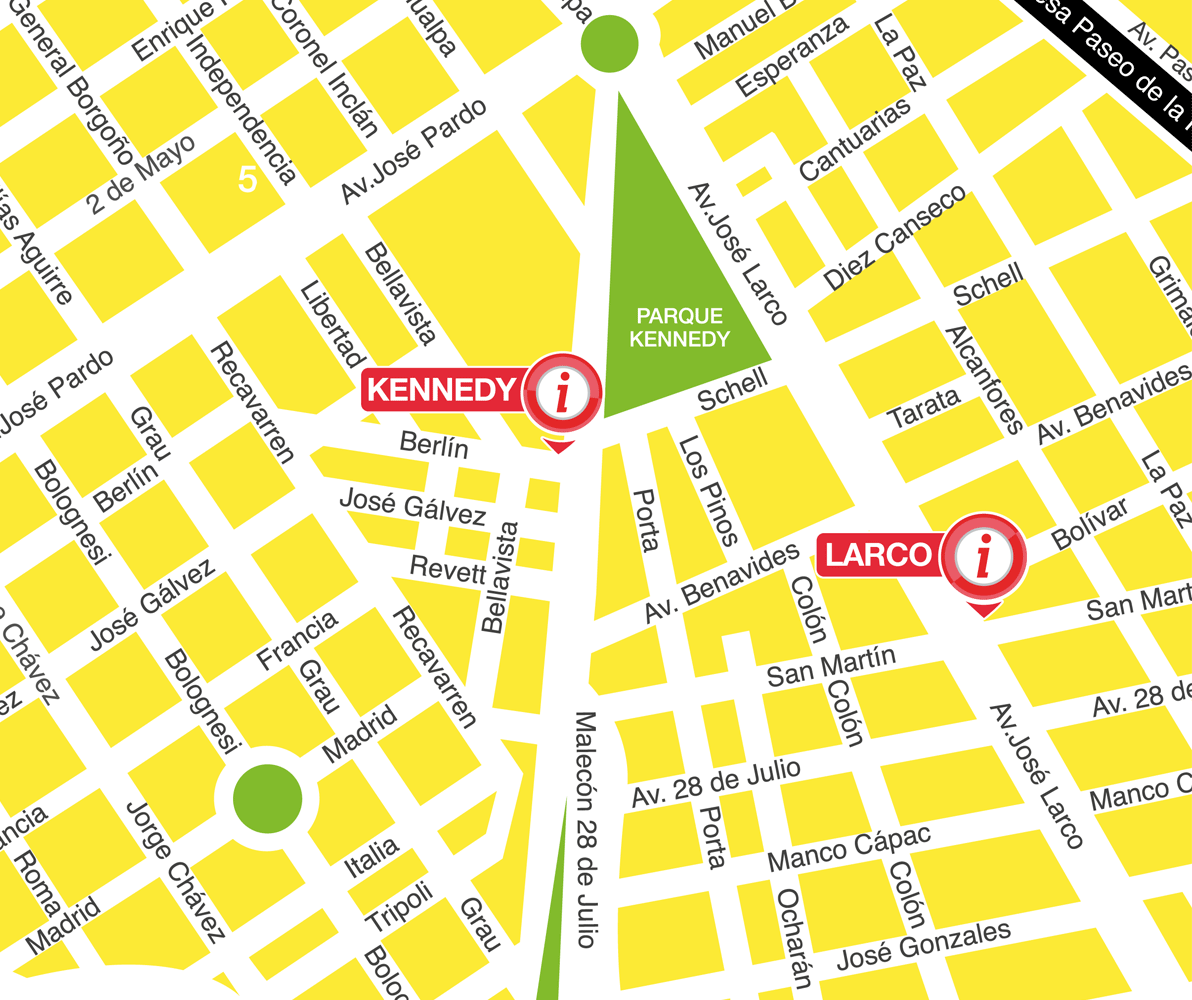
Tourist Information Center (Kennedy Park)
Av. Diagonal 494, Miraflores
Tourist Information Center (Larco)
Av. Larco 799, Miraflores
PLEASE MEET US 10 MINUTES BEFORE OUR DEPARTURE TIMES
We’re independent, licensed guides who conduct FREE Tours on a tips-only basis, thereby guaranteeing that you receive a tour of the highest quality. We'll never pressure you to tip; we believe that, if money is given, it should be voluntary and in direct proportion to the quality of the tour and the budget of the traveller.
